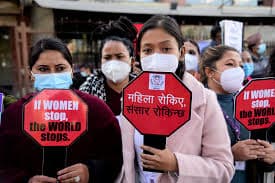
Gender-based violence in Nepal’s Madhesh Province is widespread and systemic, fueled by dowry, polygamy, economic dependence, and political protection for perpetrators, with safe houses and support systems often failing to protect survivors. WOREC’s data highlights that domestic violence dominates reported cases, revealing a deep human rights crisis rooted in patriarchal norms and institutional weaknesses.
Listening from the Ground
This article is based on field discussions and interviews with the Women Rehabilitation Center (WOREC), one of Nepal’s leading organizations working on women’s rights and survivor protection. Insights were gathered through direct conversations, case observations, and analysis of recent reports and data.
The findings reveal a troubling reality: gender-based violence in Madhesh is not just widespread—it is deeply systemic, and the systems meant to protect survivors are often failing them.
The Illusion of Safety
Safe houses are meant to be spaces of refuge, healing, and recovery. However, recent insights from WOREC suggest that these spaces are increasingly being compromised.
Following the Gen Z protests in September, several perpetrators reportedly escaped custody. In multiple cases, these individuals were able to trace survivors to safe houses. What followed was a continuation of violence—harassment, blackmail, verbal abuse, and even threats of rape and death.
For many survivors, the trauma does not end with escape. It follows them into the very spaces meant to protect them.
This exposes a dangerous gap in Nepal’s protection mechanisms: safety is treated as a moment of rescue, not a sustained process.
Patterns Emerging from the Field
Underage Survivors and Vulnerability
A significant number of survivors are underage girls, often from economically disadvantaged backgrounds. Reports indicate that hundreds—possibly over a thousand—young girls are living or working along highways, where they face heightened risks of exploitation and abuse.
Poverty, lack of education, and limited family support create conditions where violence becomes more likely—and escape becomes harder.
The Terai/Madhesh Focus
The Terai region, particularly Madhesh Province, has seen a noticeable rise in cases of sexual violence and harassment. Recent incidents, including reports of harassment in hotels, point to weak monitoring systems and inadequate enforcement of laws.
The issue is not just frequency—it is the normalization of such violence.
Structural Drivers of Violence
Dowry as Institutionalized Harm
Dowry remains one of the most deeply entrenched practices in Madhesh. What is particularly alarming is how normalized it has become.
Young men openly admit to pursuing higher education—especially in fields like medicine or engineering—with the expectation of securing higher dowries in marriage. In many cases, dowry is used to recover educational expenses, effectively turning marriage into a financial transaction.
In this system, women are not seen as equal partners—they are treated as economic assets.
Polygamy and Domestic Abuse
Polygamy continues to exacerbate violence against women. In many documented cases, when a man takes a second or third wife, the first wife becomes vulnerable to physical, emotional, and psychological abuse.
Without financial independence or strong legal support, many women are trapped in abusive households with no viable escape.
Political Protection and Impunity
The Janakpurdham case is not an isolated incident—it reflects a broader pattern of political protection shielding perpetrators.
When individuals with power evade accountability, it sends a dangerous message: justice is negotiable.
Institutional Failure: When Systems Don’t Respond
Beyond social structures, institutional failures further deepen the crisis.
In Udaypur, a burn survivor reportedly sought help through official channels, including One-Stop Crisis Management Centers (OCMC). However, the response was delayed and ineffective, highlighting serious gaps in emergency care and survivor support.
Similarly, safe houses lack adequate security systems, and law enforcement agencies often fail to track or monitor perpetrators after arrest or escape.
These failures are not isolated—they reflect systemic weaknesses across healthcare, policing, and protection mechanisms.
What the Data Reveals
A recent report by WOREC documented 141 cases of violence against women in Madhesh Province over a six-month period (March to September). The breakdown is telling:
84 cases of domestic violence
24 cases of social violence
20 cases of sexual violence
13 cases of other forms of abuse
Domestic violence alone accounts for the majority of cases, underscoring a critical reality: for many women, the most dangerous place is not outside—it is their own home.
Violence and Economic Vulnerability
Gender-based violence in Madhesh is closely tied to economic hardship. Many survivors come from families affected by debt, including “meter-byaj” (high-interest lending) systems that trap households in cycles of financial instability.
Economic dependency limits women’s ability to leave abusive environments. At the same time, individuals with histories of violence often perpetuate cycles of abuse, reinforcing a deeply rooted social problem.
A Systemic Human Rights Crisis
What emerges from this research is clear: gender-based violence in Madhesh is not a collection of isolated incidents.
It is a systemic human rights crisis—driven by patriarchal norms, economic inequality, weak law enforcement, political interference, and the normalization of harmful practices.
Without structural change, these patterns will continue across generations.
The Way Forward
Addressing this crisis requires more than outrage—it demands sustained action. Institutional reforms:
Strengthen safe house security and confidentiality systems
Improve monitoring and tracking of perpetrators
Ensure accountability in OCMC and law enforcement responses Legal accountability:
Eliminate political interference in justice processes
Fast-track gender-based violence cases Social transformation:
Challenge and dismantle dowry practices
Promote community-level awareness and education
Support women’s economic independence
Written by
Siya Pokharel
Journalist · Kathmandu