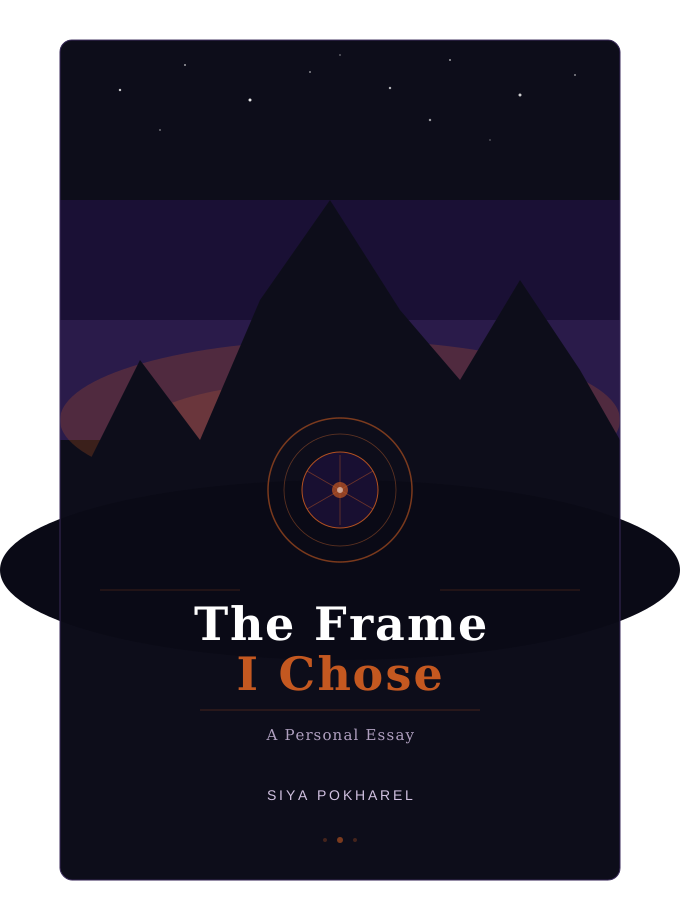
Growing up in Kathmandu, I was expected to become a doctor or engineer. Instead, I taught myself video editing, launched a YouTube channel, and became a journalist. When I finally told my father the truth, he said yes. I have chosen my frame. Now I want to learn to fill it.
There is a moment every Nepali child knows — the moment someone older asks, “What do you want to be when you grow up?” and before you can even open your mouth, they answer for you: “Don’t you want to be a doctor? An engineer?” I heard that question hundreds of times growing up in Kathmandu. And for years, I tried my hardest to give the answer they expected.
I was born in Kapilvastu and raised in Kathmandu in a warm, well-established family. My father is a government engineer — meticulous, principled, a man who built his career on precision and structure. My mother is a homemaker whose quiet strength held our family together. I grew up with every advantage: stability, education, and parents who wanted the very best for me and my younger brother.
And yet, somewhere beneath the textbooks and entrance exam prep, something in me refused to stay quiet.
The Quiet Discovery
I had always been drawn to words. As a child I wrote poems, contributed articles to school magazines, and felt most alive when I was crafting a sentence that captured something true. But in Nepal, creativity is often treated as a hobby — pleasant, but not a profession. So I kept my writing close like a secret, and focused on the things that were supposed to matter.
Then came COVID-19. The world went silent, and in that silence, I found my voice.
With nothing but time and a laptop, I discovered video editing, animation, and digital storytelling. I taught myself through YouTube tutorials, hour after hour, frame by frame. What started as curiosity quickly became obsession — and obsession, I realized, is just passion with nowhere else to go. At 16, I began taking on freelance projects. I couldn’t even receive payments yet due to lacking formal documentation, but that didn’t stop me. I wasn’t doing it for money. I was doing it because it felt, for the first time, like something that was entirely mine.
Speaking in Public Squares
I launched a YouTube channel and went to Patan Durbar Square — a UNESCO World Heritage site, a place where history breathes through stone — and I interviewed ordinary people about extraordinary things: physics, politics, the future of Nepal. What I heard surprised me. Behind the tourist smiles and the ancient facades, people were frustrated. They spoke of corruption, nepotism, a country perpetually on the edge of its own potential but never quite leaping.
One video drew too much attention. Family pressure came swiftly, and I deleted the content. It was a painful moment — being silenced when you’ve only just found your voice. But something had already taken root. I understood, in a way I couldn’t yet articulate, that media was not just entertainment. It was civic infrastructure. It was the difference between a society that sees itself clearly and one that doesn’t.
The Long Way Around
I still tried to follow the expected path. During my gap year, I prepared for the Medical Entrance Examination — a grueling process that tests not just your knowledge but your willingness to surrender your dreams to convention. At the same time, I joined IDS Media Network as a part-time social media journalist, writing scripts, producing news content, designing graphics, and delivering voice-overs. I was living two lives at once.
Together with colleagues, I co-founded “Raajnitik Bahas,” a Discord platform for political debates aimed at Nepali youth. When the government restricted YouTube and Meta in September 2025, we didn’t stop — we moved to Reddit, which remained accessible, and continued highlighting the “Nepo kid” campaign and the Gen-Z protests of 8 September. Civic engagement, I had learned, finds a way.
This work eventually reached the IT and Media Advisor to former Prime Minister Dr. Baburam Bhattarai. I later volunteered for a digital election campaign and saw, up close, how the right story told in the right way could move people. Dr. Bhattarai noticed my work and offered me perhaps the most valuable thing anyone had given me up to that point: not praise, but direction. He advised me to pursue formal education in media.
The Decision
I sat down with my father one evening and told him the truth. Not the truth he had expected, not engineering or medicine, but the truth that had been quietly assembling itself inside me for years: I wanted to make media. I wanted to tell stories. I wanted to build the kind of visual journalism that makes complex issues feel urgent and human.
He listened. And then — in the moment I had feared most — he said yes.
I think about that moment often. My father, an engineer, a man who spent his career in the world of structure and precision, chose to trust his daughter’s instincts over his own assumptions. That took its own kind of courage. His support, combined with Dr. Bhattarai’s guidance, didn’t just open a door — it made me believe I was meant to walk through it.
What I Carry Forward
I am 21 years old. I am self-taught and formally trained, a journalist and a storyteller, a girl from Kapilvastu who interviewed strangers at a World Heritage site because she believed their voices mattered. I have been censored and I have found other channels. I have been pulled toward safety and I have chosen something harder and truer.
I want to create cinematic content that blends motion graphics and powerful videography to tell stories that don’t just inform, but resonate. I want to bring Nepal’s dynamic, complicated, beautiful context to global audiences who have never thought to look. I want to be the kind of journalist who makes people feel that the story they just watched was one they needed to see.
The turning point in my life was not a single moment. It was a series of small rebellions — a YouTube channel, a Discord server, a conversation with a former prime minister’s advisor, an honest talk with my father. Each one taught me that the story you tell about yourself is the most important story you will ever produce.
I have finally chosen my frame. Now I want to learn to fill it.
Written by
Siya Pokharel
Journalist · Kathmandu