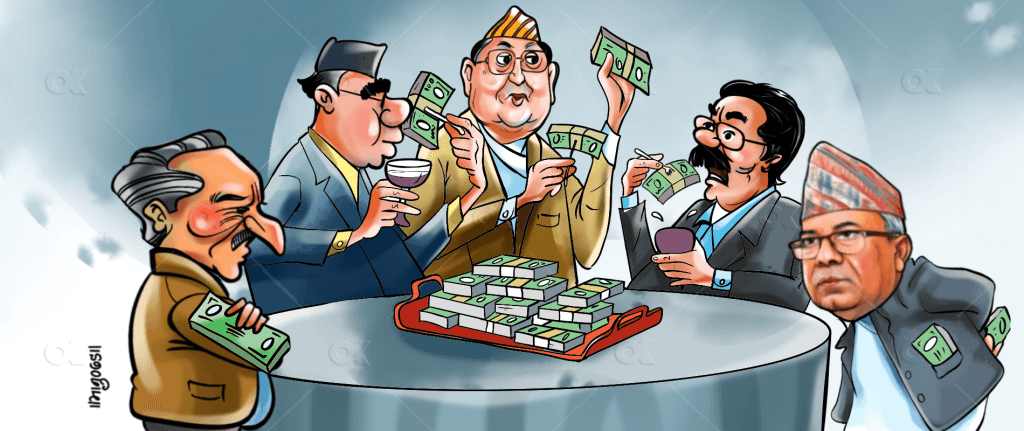
A routine visit to a government office reveals how corruption thrives not in secrecy, but in plain sight.
*During the Dashain–Tihar holidays last year, Vina travelled with her family to Janakpurdham, one of Nepal’s most revered religious sites. The visit was meant to be spiritual temple visits, family gatherings, and a brief escape from routine.
Instead, it became a moment of quiet disillusionment.
One evening, Vina accompanied her father to his government office. There, she witnessed what she describes as an ordinary interaction between officials, one that revealed how informal practices often shape formal decisions.
A colleague from another department had come to discuss a pending project. According to Vina, the official requested her father’s help to expedite the process. When he declined, citing workload, the colleague suggested they continue the discussion later in the evening.*
What followed was less a professional meeting than a social gathering. Food was ordered, alcohol was served, and conversations continued late into the night all within the premises of a government office.
For Vina, the experience was unsettling not because it was unusual, but because it appeared routine.
“It didn’t feel hidden or secretive,” she recalls. “It felt normal.”
Vina’s name has been changed to protect her identity.
A culture of normalization
Stories like Vina’s are not isolated. Interviews with young people and professionals across Nepal suggest that informal exchanges, often involving gifts, hospitality, or personal favors are widely perceived as part of how institutions function.
In some cases, these practices cross into outright bribery.
Vina recounts how a relative working in a public office was once recorded demanding NPR 2 crore in exchange for project approval. The audio circulated widely online, prompting an investigation and temporary arrest.
“But he was released soon after,” she says. “People weren’t surprised.”
The perception that influence and connections can override accountability has contributed to a growing sense of public distrust. While anti-corruption bodies exist, enforcement is often seen as inconsistent.
Transparency International’s Corruption Perceptions Index has repeatedly highlighted governance challenges in Nepal, pointing to weak institutional mechanisms and political interference.
Everyday transactions
From infrastructure contracts to administrative services, corruption is often described not as an exception but as an embedded practice.
Contractors report delays in project approvals unless “facilitation” payments are made. Citizens describe being asked for informal fees to process documents or access basic services. In some cases, even sectors such as education and healthcare are affected.
The normalization of such practices has blurred the line between what is considered acceptable and what is not.
“People adjust because they feel they have no choice,” says a Kathmandu-based policy researcher who requested anonymity. “Over time, that adjustment becomes complicity.”
Can the new government really bring the change?
With the rise of newer political figures like Balendra Shah, many young people see a possibility, however fragile of doing politics differently.
His leadership, often seen as independent and reform-oriented, has resonated particularly with urban youth who are disillusioned with traditional party structures. For some, it represents a break from the old system; for others, it is a test of whether change is truly possible from within.
This raises a larger question: can the emergence of new leadership and the energy of Gen-Z protests actually dismantle Nepal’s deeply rooted culture of corruption?
There is cautious hope.
Young people are no longer willing to accept corruption as inevitable. They are questioning authority, demanding transparency, and using their voices in ways previous generations often could not.
But hope alone is not enough.
For meaningful reform to take place, institutional accountability must move beyond symbolism. Anti-corruption bodies need independence not just in law, but in practice. Investigations must lead to consequences that are visible and consistent, regardless of political connections or social status. Without this, public trust cannot be rebuilt.
Equally important is the role of social acceptance. When corruption becomes routine, it is not only because systems allow it, but because society gradually learns to tolerate it. Refusing to participate, reporting misconduct, and demanding transparency are often framed as risky or even futile acts. But without these small acts of resistance, normalization continues unchallenged.
There are signs of change. Digital platforms have made it easier to expose wrongdoing. Public conversations around accountability are more frequent and more open than before. Young people, in particular, are less willing to accept informal practices as “just the way things work.”
Still, the gap between awareness and action remains significant.
The story Vina shared is not dramatic. There were no envelopes exchanged in secret, no overt threats or coercion. That is precisely what makes it significant. It reflects a form of corruption that does not rely on concealment, one that operates in plain sight, sustained by familiarity and repetition.
When corruption becomes routine, it does not feel like a crisis. It feels like normal life.
And that is what makes it hardest to change.
The question, then, is not only whether a new government can bring reform. It is whether institutions, and the society that surrounds them, are willing to redefine what “normal” should look like.
Published in